- Position:
- Home

- English Home
- JP group Sustainability
- Society
- Respect for Human Rights and Labor
Respect for Human Rights and Labor
Human Rights Initiatives
Establishment of the Human Rights Policy
In response to growing societal expectations for companies to respect human rights, the Japan Post Group established the Japan Post Group Human Rights Policy in April 2019 based on the United Nations (UN) Guiding Principles on Business and Human Rights and other relevant frameworks.
Through this Policy, we demonstrate our commitment to respecting human rights, establish a human rights due diligence framework to identify adverse impacts on human rights, and promote human rights awareness activities to foster respect for human rights among all employees. We also support the UN Children's Rights and Business Principles and promote the realization of children's rights.
Human rights awareness activities are reviewed periodically through deliberations of the Group Sustainability Committee, taking into account changes in corporate activities and the business environment.
The Group's structure for promoting human rights awareness
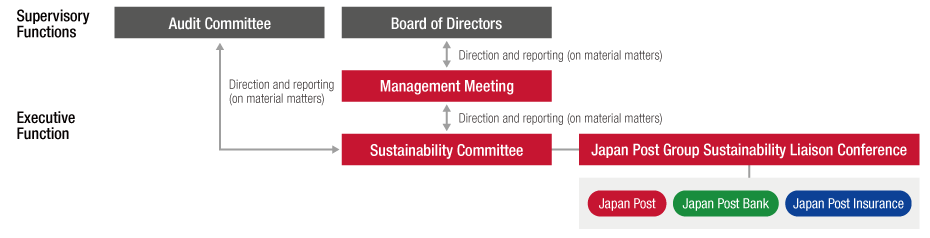
Dialogue with Outside Experts
Recognizing the importance of business and human rights, we will continue to deepen our initiatives based on advice from external experts. We are strengthening our implementation framework, establishing clear policies and guiding principles, and promoting a shared understanding within the Company of the importance of sustainability management as recognized by senior management.
Implementing human rights due diligence
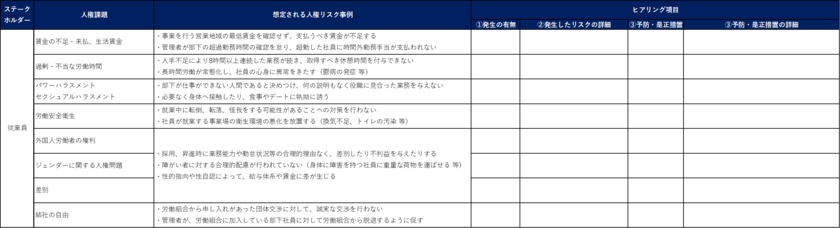
The Japan Post Group undertakes the following human rights due diligence process in order to respect the human rights of persons who are impacted by its business activities.
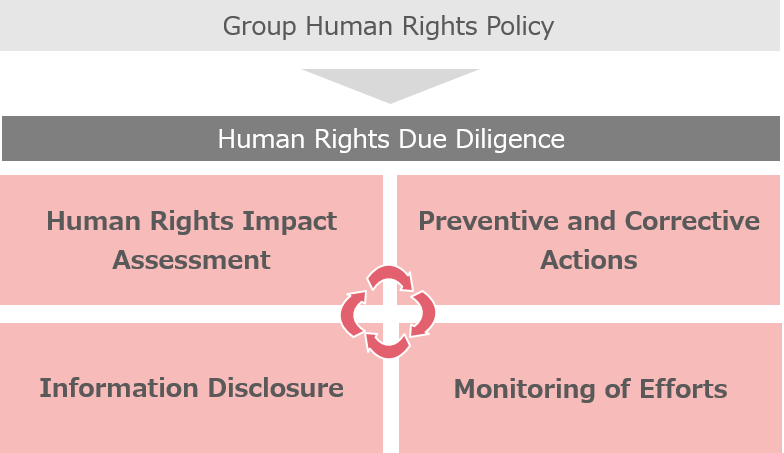
*Note: In-house seminars on business and human rights are held for all employees of Japan Post Holdings, the Group's holding company, by inviting a lecturer from the Tokyo Legal Affairs Bureau.
Human Rights Impact Assessment
With one of the largest workforces in Japan, the Japan Post Group operates a variety of businesses, including postal services, logistics, banking, and insurance, through about 24,000 post offices nationwide. We identify priority issues by mapping the latent and overt human rights risks associated with our businesses.
In identifying priority issues, we draw on various guidelines and external literature reviews,*1 employee awareness questionnaire on business and human rights,*2 assessment surveys of major subsidiaries,*3 and the expertise of external consultants.
| Stakeholder | Priority issue |
|---|---|
| Employee | Insufficient or unpaid wages; living wage | Excessive or unreasonable working hours |
| Power harassment and sexual harassment | |
| Occupational health and safety | |
| Discrimination (including gender-related human rights issues) | |
| Customer | Privacy rights |
| Consumer safety and right to know | |
| Supplier | Forced labor ・ Human trafficking |
| Child labor | |
| Recipient of investment/financing | Forced labor ・ Human trafficking |
| Child labor | |
| Rights of indigenous people and local residents |
We will manage and review the human rights issues of particular concern to us through monitoring, etc. We will also work to mitigate risks related to human rights issues other than those listed above.
*1 Various guidelines and external literature reviews
-
■Referenced literature:
-
・"Report on the Research and Study on Business and Human Rights (March 2021)." The Ministry of Justice
-
・"Handbook for Management that Respects Human Rights (December 2021)." Keidanren
-
・"Human Rights Issues by Sector v.10 (March 2022)." Caux Round Table Japan (CRT Japan)
-
・"Human Rights Guidance Tool/Services (2014)." UNEP FI
-
・"10 Human Rights Priorities for the Financial Sector (2017)." BSR
-
・"10 Human Rights Priorities for the Transport and Logistics Sector (2017)." BSR
| Human rights issues | UNFPFI (Services) |
BSR (Finance) |
BSR (Transport and logistics) |
CRT (Logistics and transport) |
|---|---|---|---|---|
| (1) Insufficient or unpaid wages; living wage | ✔ | ✔ | ✔ | |
| (2) Excessive or unreasonable working hours | ✔ | ✔ | ✔ | |
| (3) Occupational safety and health | ✔ | ✔ | ||
| (4) Right to social security | ||||
| (5) Power harassment | ||||
| (6) Sexual harassment | ||||
| (7) Maternity/paternity harassment | ||||
| (8) Nursing care harassment | ||||
| (9) Forced labor | ✔ | ✔ | ✔ | |
| (10) Freedom of change of residence | ||||
| (11) Freedom of association | ✔ | |||
| (12) Rights of foreign workers | ✔ | ✔ | ||
| (13) Child labor | ✔ | ✔ | ||
| (14) Human rights issues related to technology and AI | ✔ | ✔ | ||
| (15) Privacy rights | ✔ | ✔ | ||
| (16) Consumer safety and right to know | ✔ | ✔ | ||
| (17) Discrimination | ✔ | ✔ | ✔ | ✔ |
| (18) Gender-related human rights issues | ✔ | ✔ | ✔ | |
| (19) Freedom of expression | ||||
| (20) Rights of indigenous people and local residents | ✔ | ✔ | ||
| (21) Human rights issues related to the environment and climate change | ✔ | ✔ | ||
| (22) Intellectual property rights | ||||
| (23) Bribery and corruption | ✔ | ✔ | ✔ | |
| (24) Human rights issues in the supply chain | ✔ | ✔ | ✔ | |
| (25) Right of access to redress | ✔ | ✔ |
*2 Employee awareness questionnaire on business and human rights (conducted in FY2022)
-
■Target company: Japan Post Holdings
-
■Question:
-
Choose the top three issues that are highly likely to become priority human rights issues in the business activities of the Japan Post Group.
-
(To be chosen from 25 human rights risks listed in the "Report on the Research and Study on Business and Human Rights (March 2021)" by the Ministry of Justice.)
-
■Number of respondents: 965 (Response rate: approx. 90%)
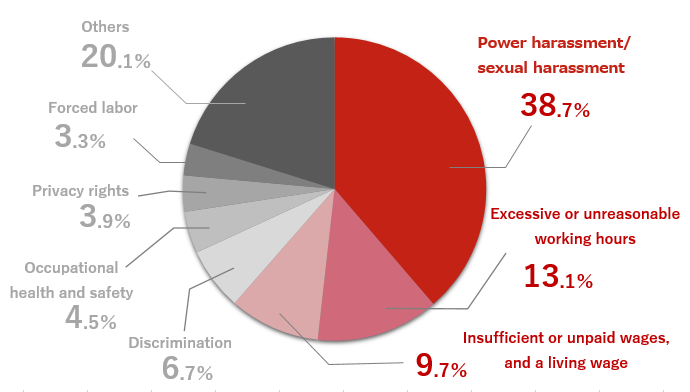
*3 Outline of assessment survey
-
■Target companies:
-
・Japan Post Holdings
-
・Japan Post Co., Ltd.
-
・Japan Post Bank Co., Ltd.
-
・Japan Post Insurance Co., Ltd.
-
■Survey method:
-
I.Identify human rights issues expected in the Group's business areas from external literature, etc.
-
II.For the identified human rights issues, conduct a survey of each company on the occurrence or non-occurrence of the issue and preventive/corrective actions using an interview sheet.
-
III.Integrate the survey results for each company and identify the human rights issues to which the Group should pay particular attention.
Preventive and Corrective Actions
Preventive and Corrective Actions The following shows the implementation of preventive and corrective measures against the negative impact of apparent and latent risks relating to human rights. We will review and enhance activities according to the situation of the assessed impact on human rights.
| Stakeholder | Human rights issues | Main examples of preventive and corrective actions | |
|---|---|---|---|
| Education and training | Internal environment and systems | ||
| Employee | Insufficient or unpaid wages; living wage |
|
|
| Excessive or unreasonable working hours |
|
|
|
| Power harassment and sexual harassment |
|
|
|
| Occupational health and safety |
|
|
|
| Discrimination (including gender-related human rights issues) |
|
|
|
| Customer | Privacy rights |
|
|
| Consumer safety and right to know |
|
|
|
| Supplier | Forced labor |
|
|
| Child labor | |||
| Recipient of investment/financing | Forced labor |
Related disclosures
|
|
| Child labor | |||
| Rights of indigenous people and local residents | |||
| Other |
|
||
Implementation of monitoring of initiatives
The following shows monitoring of the risks related to human rights. We will review monitoring items and methods according to the status shown by the assessment of the impact on human rights.
- Employee and workplace environment surveys
- Human rights and harassment check (twice a year)
- Stress Checks at all business locations (once a year)
- Improvements to workplace environment by inviting employees to give examples of near misses at business locations
- Initiatives to correct excessive overtime
Checking the number of hours of overtime at each department (monthly), monitoring of working hours and others on site (as necessary), managing working hours by checking IC cards (monthly) - Fatigue Checks, encouragement of meetings with industrial physician (for employees with 80 hours or more of overtime per month; monthly)
- Mental disorder detection program (for employees working more than 80 hours of overtime per month and employees who have transferred from outside the company; monthly)
- Exchanging opinions with the labor union
- Holding a subcommittee meeting with the labor union to discuss work-life balance and other matters (once to twice a year)
- Exchanging opinions with the branches of the labor union on such matters as actual overtime hours once every two months
- Holding a subcommittee meeting with the labor union to discuss gender equality and other matters (once to twice a year).
- Supply chain management
- Co-Creation in Supply Chain
In modern Supply Chain, we are required to address many issues such as respecting human rights, environmentally friendly and prevention of corruption to engage in CSR/Sustainable procurement. Business enterprises are increasingly expected to promote CSR/Sustainable procurement initiatives in accordance with the “Guiding Principles on Business and Human Rights” and the “Sustainable Development Goals (SDGs)” that are established by the United Nations
The Japan Post Group is committed to procurement activities for environmentally friendly and coexistence with local communities based on “Japan Post Group’s Approach to Procurement Activity” and “Japan Post Group CSR/Sustainable Procurement Guideline” in collaboration with our suppliers and complies with the Ten principles of the United Nations Global Compact.
As part of our Procurement activities, Japan Post holdings conducts the survey using the “CSR/Sustainable Procurement Self-Assessment Questionnaire” since 2019, assesses risks related to compliance, environmental, human rights, labor, quality and safety, and anti-bribery issues, and strives to identify potential risks in supply chain. Even if some issues are revealed by the survey result, we will not suspend or terminate the transaction suddenly. We seek to promote CSR/Sustainable activities with our suppliers through bidirectional communication. In 2023, we revised questions and scoring allocation of the “CSR/Sustainable Procurement Self-Assessment Questionnaire” considering the results of past surveys or global situation. We have formed some groups by industry and have been making efforts to identify specific risks of each group.
In addition, we also conduct a survey on human rights protection for a new supplier and confirm their initiatives concerning human rights, thereby verifying human rights risks.
In 2024, we also added contents related to human rights protection in the CSR clause that is added to our standard contract in 2021 for the purpose of promoting CSR/Sustainable procurement throughout supply chain and designated it as the CSR and human rights clause. We clarified that we would move forward with our initiatives to respect human rights with all our suppliers besides CSR/Sustainable procurement.
Furthermore, we actively work on anti-bribery initiatives such as background checks to identify any links to organized crime of suppliers when we enter a contract with new suppliers, and incorporating anti-social forces clause and anti-money laundering clause into our standard contract.
- Co-Creation in Supply Chain
The result of CSR/Sustainable survey (FY2025)
■Target of this survey・Implementation period September 26, 2025~November 30, 2025
・Number of target suppliers
| Number of target suppliers | Number of respondents | Response rate |
|---|---|---|
| 62 | 44 | 70.9 |
We conduct a survey using a “CSR/Sustainable procurement Self-Assessment Questionnaire” developed by the Global Compact Network Japan (GCNJ) in 2017, for the purpose of understanding potential Sustainability Risk and making sure to adhere to “the Japan Post Group CSR procurement Guidelines” which shows our way of thinking on procurement in our supply chain.
In the survey, we assess supplier’s achievement level of initiatives in figure below by scoring from the view of following five items, “Recognizing a law”, “Policy”, “Structure and Responsibility”, “Adhere to the results of initiatives” and “Correction”. (116 questions in total)
□ To formulate Business Continuity Plan(BCP)
□ To establish Internal Reporting System
□ To post information to inside and outside the company
□ To respect human rights and prohibit discrimination
□ To raise awareness to prevent human rights violation
□ To respect life and culture of indigenous
□ To provide learning opportunities for employees
□ To prohibit harassment, abuse, and violence
□ To prohibit forced labor, Slave labor, missing labor, and inhumane labor
□ To prevent unfair wages, salary reduction and labor that exceeds statutory limits
□ To establish a union and to ensure the rights to collective bargaining
□ To ensure proper management of chemicals in compliance with applicable laws
□ To consider water resources and biodiversity and to conduct assessment
□ To prohibit abuse of superior bargaining position and collusion
□ To prohibit conflicts of interest
□ To respect and protect intellectual property
□ To eliminate relationship with organized crime groups
□ To protect against computer network threats
□ To identify and manage the use and country of origin of conflict minerals and cobalt
■Aggregation results
The response rate of this survey in 2025 was 70.9%, 6.3points increased from last fiscal year’s 64.6% in line with growing awareness about CSR/Sustainable procurement among all suppliers. The average of scoring rate that measures achievement was 87.8%, 3.8 points increased from last fiscal year’s 84.0%. By category, (1) Corporate Governances (3) Labor and (5) Fair business practices (7) Information Security received high score, on the other hand, (8) Supply chain and (9) Coexistence with Local society scored low.

- 1.Give feedback to suppliers
We give all suppliers who responded to this survey with feedback on their results. We distribute to each supplier a document that shows their scores in the nine categories. - 2.Supplier Monitoring
We conduct monitoring online or through in person visits to suppliers’ offices to strengthen communication with our suppliers, regardless of the survey results.
For suppliers with low scores, we give advice to them for improving their efforts or establishing their internal structure by showing them best practices of other suppliers after hearing the status of their efforts.
For suppliers with high scores, we ask them to share best practices of their initiatives and to have their support for improving CSR/Sustainable procurement throughout our supply chain.
In 2025, we conducted monitoring of 18 suppliers. - 3.Follow-up for non-respondents
For suppliers who did not respond to the questionnaire, we will continue to encourage their cooperation after helping them understand the purpose of this survey. Moreover, we strive to share information on CSR/Sustainable procurement policy with suppliers proactively by providing such information on the website, and to deepen engagement with suppliers through supplier monitoring or informational session.
Declaration of Partnership Building
The Japan Post Group has issued its "Declaration of Partnership Building" to promote stronger relationships with suppliers, further strengthen fair and sound business practices, and create new value throughout the supply chain while responding to societal expectations.
Information Disclosure
Remedial measures
As part of its efforts to promote human rights awareness and eradicate harassment, the Group raises awareness through various training programs and has established consultation and reporting channels, including a "One-Stop Consultation and Reporting Platform," where employees can seek advice and report concerns with confidence. Through these channels, we strive to identify and appropriately address employee concerns relating to compliance matters.
When consultations or reports concerning harassment are received, we conduct investigations in accordance with the wishes of the reporting individual and determine whether harassment has occurred. Where harassment is identified, the Group responds strictly in accordance with the disciplinary rules established by each Group company.
In addition, depending on the nature of the case, appropriate remedial and corrective measures may be taken, including reflecting the matter in personnel evaluations and implementing personnel transfers.
| Japan Post Group | FY2021 | FY2022 | FY2023 | FY2024 | FY2025 |
|---|---|---|---|---|---|
| Number of cases of harassment* | 88 | 108 | 124 | 147 | 142 |
* Number of cases of disciplinary action relating to harassment
In FY2025, the incidence rate among all employees (approximately 370,000 employees) was approximately 0.03%.
* Coverage: Japan Post Holdings Co., Ltd., Japan Post Co., Ltd., Japan Post Bank Co., Ltd., and Japan Post Insurance Co., Ltd.
Labor Initiatives
Developing human resource systems adapted to changes in the business environment
In response to rapid changes in the business environment, the Japan Post Group is reviewing its workforce composition with a view to its future business structure and addressing legal requirements, including those related to equal pay for equal work.
In addition, we will continue promoting fixed-term employees to regular employee positions, pursue further improvements in employment conditions, and work toward a simpler and more transparent compensation system that employees can better understand and accept.
Initiatives to reduce working hours
The Japan Post Group complies with laws and regulations relating to working hours, Agreement 36 (Labor-Management Agreements relating to Overtime Work and Work on Days Off), and maintains a policy of reducing excessive working hours.
Under this policy, we implement a variety of initiatives so that employees can fully demonstrate their abilities and work with energy and engagement. We comply with relevant laws and regulations, including those governing maximum working hours, minimum wages, payment for overtime work, and the granting of annual paid leave. In addition, we promote appropriate working hours management at each workplace, reduce overtime through operational efficiency improvements and workplace culture reform, and encourage employees to take annual paid leave.
Complying with Industrial Safety and Health Act and related laws and regulations
The Japan Post Group complies with the Industrial Safety and Health Act and related laws and regulations and maintains ongoing monitoring and oversight to prevent violations in its existing business operations.
We also check, when establishing a new company or conducting an M&A transaction, whether systems are in place to ensure compliance with the Industrial Safety and Health Act and related laws and regulations and prevent legal violations.
Increase in Wages
As a basic policy, the Japan Post Group complies with labor-related laws and regulations and ensures that all employees are paid wages above the applicable regional minimum wage, while providing appropriate compensation based on job responsibilities and position, so that employees can maintain the minimum standards of wholesome and cultured living as set out in Article 25 of the Constitution of Japan.
In addition, we conduct annual labor-management consultations to improve wage levels, including salaries, bonuses, and various allowances, so that employees and their families across all regions can enjoy a more prosperous life. We will continue striving for further improvements.
The Japan Post Group supports the principle of equal remuneration for men and women for work of equal value set out in ILO Convention No. 100 (Equal Remuneration Convention). Accordingly, we establish compensation standards without discrimination based on gender for work of equal value.
We also regularly monitor differences in average wages between men and women.
Compliance with labor-related laws and regulations
In its existing business operations, the Japan Post Group complies with labor-related laws and regulations and maintains ongoing monitoring and oversight to prevent legal violations.
In addition, when establishing new companies or conducting M&A transactions, we verify that systems are in place to ensure compliance with labor-related laws and regulations and prevent legal violations.
Labor-management relations
The Japan Post Group respects labor rights, including the right to organize and the right to engage in collective bargaining and other collective activities, in accordance with the Constitution of Japan and the Labor Union Act.
Labor unions, including the Japan Postal Group Union, are organized within the Japan Post Group. Collective bargaining is conducted on an equal footing between labor and management regarding a wide range of working conditions, including employee wages and working hours.
* Number of employees covered by collective bargaining agreements (Japan Post Holdings, Japan Post, Japan Post Bank, and Japan Post Insurance): Approximately 320,000 employees (approximately 89.9% of the total employees of the four companies; as of the end of March 2026)
Relevant information

- Japan Post Group Sustainability
- Sustainability Management
- Policy, Approach and Framework
- Material Issues Relating to Sustainability
- Promotion of Sustainability Management
- ESG investments
- Integration of ESG factors into asset management and involvement in joint initiatives
- Sustainability Finance
- Dialogue with Stakeholders
- Endorsement of Initiatives
- External Assessments
- Environment
- Environmental Management System
- Response to TCFD and TNFD recommendations
- Targets, Results, and Other Matters Related to Climate Change
- Initiatives Related to Climate Change
- Responding to biodiversity conservation
- Targets, Results, and Other Matters Relating to Pollution Control and Resources Recycling
- Pollution Control and Recycling Initiatives
- Society
- Development and Revitalization of Local Communities
- Promoting Healthy Lifestyles
- The Group Human Resources Policy
- Creating Friendly Workplaces for Employees
- Promotion of Diversity
- Human Resources Development
- Health Management Initiatives

- Occupational Health and Safety Initiatives
- Japan Post Group Human Rights Policy
- Respect for Human Rights and Labor
- the Basic Policies for Customer-First Business Operations
- Japan Post Group's Approach to Procurement Activity
- Japan Post Group CSR Procurement Guidelines

- Supply Chains
- Governance
- ESG-related Information
- Topics related to Group Sustainability
- Sustainability Management