- Position:
- Home

- English Home
- JP group Sustainability
- Sustainability Management
- Material Issues Relating to Sustainability
Material Issues Relating to Sustainability
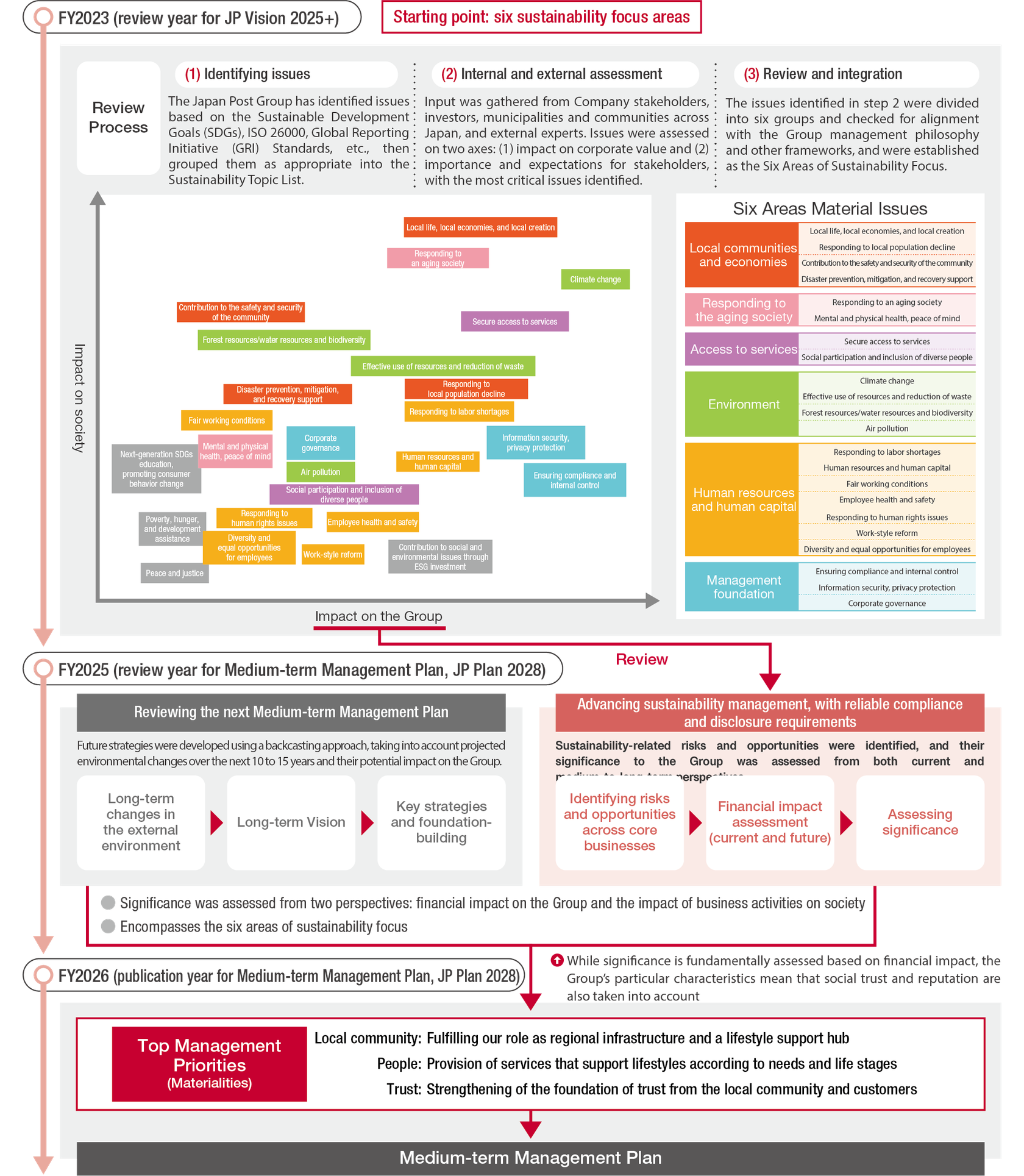
In order to clarify the material issues to be addressed regarding sustainability, the Japan Post Group has identified issues based on the Sustainable Development Goals (SDGs), ISO 26000, Global Reporting Initiative (GRI) Standards, etc., and has created the "Sustainability Topic List." Based on this list, we conducted a questionnaire to stakeholders of the Group, and evaluated the two axes of "impact on corporate value" and "importance and expectations for stakeholders" with reference to the opinions of institutional investors, etc., and the opinions of experts in municipalities and regions across the country, and identified particularly important issues. After further grouping these issues and confirming their consistency with the Management Philosophy and the Medium-Term Management Plan, we organized them into six areas and clarified the direction of each initiative.
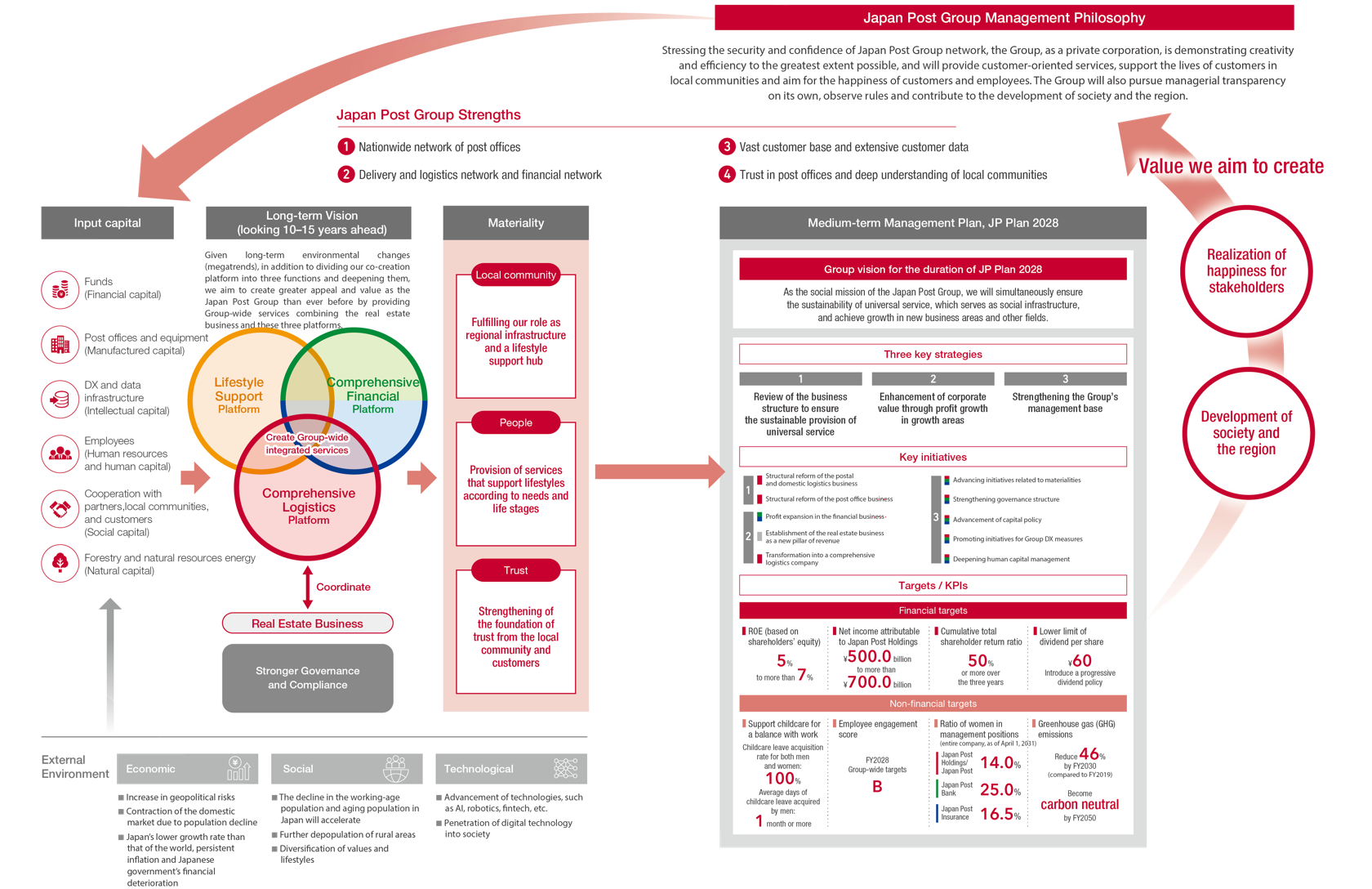
Top Management Priorities (Materialities)
We reviewed the six areas of material sustainability issues identified in 2023 from the perspective of sustainability-related risks and opportunities. Based on an assessment of their importance to the Group from both current and medium- to long-term perspectives, we integrated them into three top management priorities (materialities): “Local Community,” “People,” and “Trust.”
Process for Identifying Material Sustainability-Related Issues
The material issues were determined through the following process upon discussions by the Sustainability Committee, the Management Meeting, and the Board of Directors.
Long-Term Vision

Topics were identi ed by referring to the SDGs, ISO 26000, GRI Standards, etc., grouped, and extracted as the "Sustainability Topic List."


-
The issues extracted in Step 1 were evaluated on two axes: "impact on corporate value "and" importance and expectations for stakeholders" with reference to the following, and particularly important issues were identi ed.
- Japan Post stakeholders
- ■ Questionnaire to our executives, employees, customers, and business partners
- Investors, etc.
- ■ Opinions of institutional investors
- ■ Relationship with matters regarded as important topics by industry in the Sustainability Accounting Standards Board (SASB) Standards
- Region
- ■ Matters expected from post of ces by municipalities across Japan
- Experts
- ■ Opinions of local experts
The "Survey Results on Regional Contributions Required of Post Of ces (Flash Report) (November 21, 2022)," conducted by the Postal Administration Department under the Ministry of Internal Affairs and Communications, reects the responses from municipalities across Japan regarding "areas that we would like to work on in cooperation with post of ces."
Reects opinions and requests to the Group at group meetings for regional opinion leaders conducted by Japan Post Co., Ltd. branch of ces - ■ Results of dialogue with experts on sustainability, etc.

After grouping the particularly important topics and their closely related topics, their consistency with the Management Philosophy and Medium-Term Management Plan was veri ed and sorted into six areas, and the direction to be taken by each initiative was clarified.
Value Creation Process
Material Sustainability-Related Risks and Opportunities
The Japan Post Group identifies potential sustainability-related risks with reference to the SASB Standards, industry peers, and risks associated with our businesses. Each department then identifies and organizes specific risks and opportunities to develop a comprehensive long list.
These risks and opportunities are evaluated based on two dimensions: (1) their likelihood of occurrence and potential impact on each business, assessed through both qualitative and quantitative analysis, and (2) their impact on the Japan Post Group’s trust and reputation. Following deliberation among relevant departments, we identify material sustainability-related risks and opportunities.
For information on the material sustainability-related risks and opportunities associated with each of our businesses, including those related to climate change, environmental initiatives, human capital, diversity, and governance, please refer to the link below.
- Japan Post Group Sustainability
- Sustainability Management
- Policy, Approach and Framework
- Material Issues Relating to Sustainability
- Promotion of Sustainability Management
- ESG investments
- Integration of ESG factors into asset management and involvement in joint initiatives
- Sustainability Finance
- Dialogue with Stakeholders
- Endorsement of Initiatives
- External Assessments
- Environment
- Environmental Management System
- Response to TCFD and TNFD recommendations
- Targets, Results, and Other Matters Related to Climate Change
- Initiatives Related to Climate Change
- Responding to biodiversity conservation
- Targets, Results, and Other Matters Relating to Pollution Control and Resources Recycling
- Pollution Control and Recycling Initiatives
- Society
- Development and Revitalization of Local Communities
- Promoting Healthy Lifestyles
- The Group Human Resources Policy
- Creating Friendly Workplaces for Employees
- Promotion of Diversity
- Human Resources Development
- Health Management Initiatives

- Occupational Health and Safety Initiatives
- Japan Post Group Human Rights Policy
- Respect for Human Rights and Labor
- the Basic Policies for Customer-First Business Operations
- Japan Post Group's Approach to Procurement Activity
- Japan Post Group CSR Procurement Guidelines

- Supply Chains
- Governance
- ESG-related Information
- Topics related to Group Sustainability
- Sustainability Management